


In praise of surgery
I openly challenge the manufacturers of drugs used in breast cancer treatment, as well as their representatives in clinical practice — physicians who treat breast cancer with medication. My position is clear and understandable to everyone except them: the patient’s best interest is to surgically remove the cancer from the body as soon as possible and to administer drug therapy after surgery. Their position appears to make sense only to them: they seek to marginalise surgery and remove it from breast cancer treatment, thereby increasing the use of their drugs and their financial profits, regardless of the fact that this may reduce patients’ chances of being cured.
My arguments are the scientific studies that I continually cite and that are available to everyone. I also have arguments that are not available to everyone: surgical procedures that cured patients who, without surgery, would have had no chance of recovery. I have encountered many such cases throughout my career. Here I present two of them, so that these previously unseen arguments may become available to everyone.
Case Report – Patient M. J.
Surgery Leading to the Cure of an “Incurable” Breast Cancer
Patient M. J. (born in 1948) was treated for breast cancer between 2016 and 2018 using all therapeutic modalities: surgery, chemotherapy and radiotherapy.
When she came to M.C. Aesculap in 2018, she had an ulcerated, bleeding tumour approximately 10 cm in size in the right axilla — a recurrence of the cancer following mastectomy — as well as a large mass of metastatic lymph nodes in the axillary and infraclavicular regions, extending to the point where the major blood vessels of this region enter the chest. She had no distant metastases.
She brought with her the decision of the oncology multidisciplinary team from the Clinical Centre where she had previously been treated. It stated that all available treatment modalities had been exhausted and that further palliative treatment through her local primary healthcare centre was recommended.
However harsh it may sound, such a recommendation effectively meant that the patient was expected to remain at home with a tumour that was slowly destroying her tissues, while community healthcare staff periodically dressed the wound and administered pain medication, awaiting the inevitable outcome.
Expected survival: 2–3 months.
Our decision to operate on the patient despite the advanced stage of the disease and the opinion of a relevant oncology multidisciplinary team was not made lightly.
On the one hand, we were encouraged by the patient’s own attitude. She was fully aware of her situation and prepared to accept all the risks. We were also encouraged by the fact that, because she had no distant metastases, a successful operation could achieve a great deal — and, above all, by our conviction that we could successfully perform such a delicate surgical procedure.
On the other hand, the surgical risks involved in separating metastatic lymph nodes adherent to the major blood vessels at the entrance to the chest were exceptionally high.
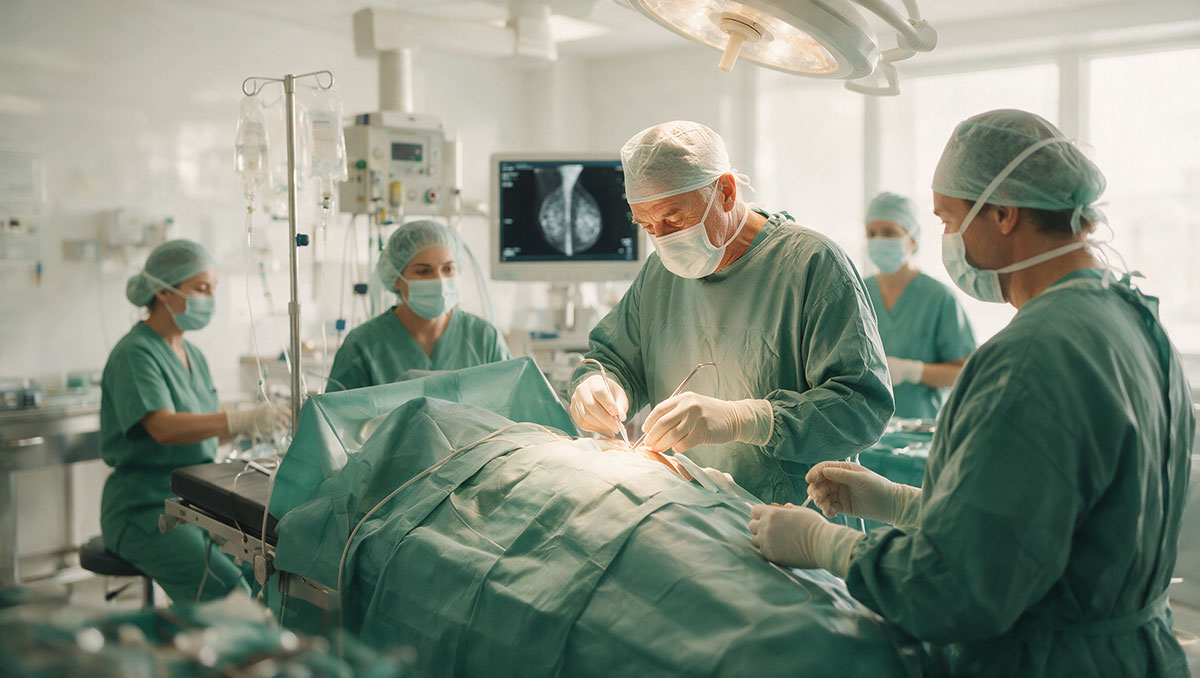
Through a meticulous surgical procedure lasting nearly six hours, we succeeded in removing all tumour tissue surgically — both the large axillary tumour and all pathological lymph nodes at the higher levels that were adherent to the major blood vessels.
It is difficult to describe the happiness a surgeon feels after such an operation — an operation that transforms a patient’s fate from dying in the most terrible suffering to regaining the dignity of being free from a devastating disease.
I experience that happiness all over again whenever I see the name of patient M. J. on the list of patients scheduled for a follow-up examination.
I last saw her for a follow-up examination in March 2026.
She was completely healthy.
Case Report – Patient S. B.
How to Make Breast Cancer Treatment More Humane
Patient S. B. (born in 1980), a mother of two children at the time, came to see me in 2010 with a report from our country’s largest oncology institution.
A biopsy had been performed there on a 2 cm breast cancer in her right breast, while at the same time she had a 6 cm mass of metastatic lymph nodes in her right axilla.
The oncology multidisciplinary team at that institution recommended beginning treatment with chemotherapy. She did not accept this recommendation, after which the team decided that it would no longer manage her case, even though both the tumour and the metastatic lymph nodes were surgically removable and the patient herself was willing to undergo surgical treatment.
Naturally, I operated on the patient immediately. A radical mastectomy was performed, successfully removing all tumour tissue from her body.
After surgery, the patient declined the recommended chemotherapy and radiotherapy for personal reasons. She felt that these forms of treatment were too aggressive for her delicate constitution — I do not believe she ever weighed more than 50 kg.
She was religious and followed a vegan diet, while also using various medicinal-plant-based supplements.
We established a programme of regular follow-up examinations, which she attended consistently.
Approximately six years after the operation, during one of her routine follow-up appointments, she told me that she was pregnant and wanted to have the child.
I admit that I felt apprehensive about the future course of her disease, but she remained firm in her decision and accepted full personal responsibility for it.
She gave birth and continued attending her regular follow-up examinations.
Another four years passed without any pathological findings, when she once again told me that she was pregnant and intended to have the child.
This time I accepted her decision more calmly, although I was still concerned. By then, however, I had long since become accustomed to her unwavering character.
Her youngest child — she now has four sons — is seven years old, and she continues to attend follow-up examinations diligently every six months.
Her most recent follow-up examination was performed on 18 August 2026.
The patient is completely healthy and even looks fresher and more youthful than before.
Prof. Dr Nebojša Ivanović
18 August 2026
